

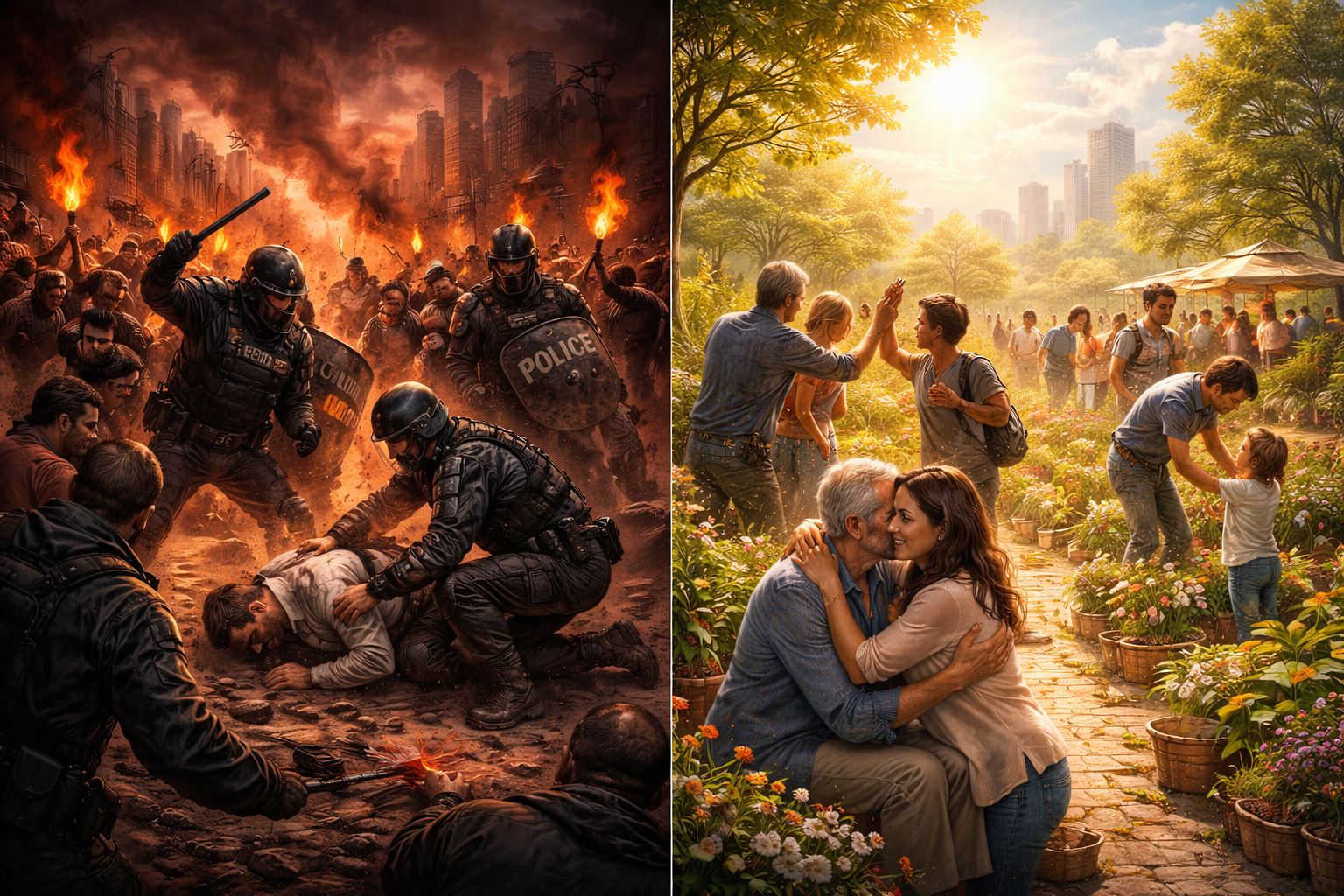
The Myth of Ideological Neutrality
There exists a curious assumption at the heart of modern democratic thought: that all ideas, by virtue of being expressible, deserve equal consideration in the marketplace of political discourse. Democracy, we are told, is the system where every voice can be heard, where any opinion might eventually find its way into policy through the will of the majority. This sounds noble. It sounds fair. It is also, upon closer examination, profoundly incoherent.
The premise rests on a hidden axiom, that all ideas are equally acceptable, equally valid, equally deserving of political expression. Under this framework, hatred stands on equal footing with compassion. Selfishness claims the same legitimacy as solidarity. The impulse toward violence demands the same respect as the commitment to peace. The accumulation of wealth by the few asks for the same consideration as its distribution among the many.
We have confused the right to speak with the validity of what is spoken.
Nature’s Undemocratic Wisdom
Look anywhere in the living world, and you will find this democratic neutrality of ideas thoroughly contradicted.
Consider your own body. Imagine if one organ decided that hoarding all available nutrients was as acceptable as distributing them throughout the system. Imagine if your liver concluded that its interests were sovereign, that it need not concern itself with the needs of your heart or your brain. The result would not be a thriving democracy of organs. The result would be death.
Your immune system does not operate on the principle that all cellular behaviours are equally valid. It does not extend equal consideration to the cells that protect you and the cells that would destroy you. It discriminates. It attacks what threatens the whole. It does so not out of prejudice but out of the necessity of survival.
In any ecosystem, cooperation is not merely one option among many, it is the condition of flourishing. The forest does not survive because each tree pursues its interests without regard to the others. The mycorrhizal networks beneath the soil, the exchange of nutrients between species, the delicate balance of predator and prey, all of this speaks to a deeper principle: that life itself is organised around interconnection, around the recognition that the part cannot thrive at the expense of the whole.
The Neighbourhood of Existence
Bring this closer to human scale. Imagine a neighbourhood where murdering your neighbour was considered as acceptable as building community with them. Imagine a street where theft was granted the same social standing as generosity. Would this be a flourishing community? Would this be a place where children could play safely, where the elderly could live with dignity, where anyone could find meaning and connection?
The question answers itself. And yet this is precisely the logical conclusion of the doctrine that all ideas deserve equal political standing.
We do not actually believe this doctrine. We cannot believe it and continue to function. Every parent who teaches their child that kindness matters more than cruelty, every community that distinguishes between contribution and exploitation, every society that maintains laws against violence, all of these give the lie to our professed belief in the equality of ideas.
The Self-Consuming System
Here lies the fatal paradox of democracy as currently conceived: by treating all ideas as equally valid, it extends legitimacy to ideas that would destroy it. The fascist is welcomed into the democratic forum, granted equal time, equal consideration. After all, who are we to say that one political vision is superior to another?
The fascist, of course, suffers from no such confusion. He knows exactly which ideas he considers superior. He uses the openness of the democratic system as a doorway, then locks it behind him.
This is not a theoretical concern. It is the story of the twentieth century, repeated now in the twenty-first. Democratic systems that pride themselves on their tolerance extend that tolerance to movements whose explicit purpose is the elimination of tolerance itself.
The error is in the premise. Not all ideas are equal. The idea that we should care for one another is not equivalent to the idea that some people are disposable. The idea that power should be distributed is not equivalent to the idea that power should be concentrated in the hands of a strongman. The idea that every person has inherent worth is not equivalent to the idea that worth is determined by race or nation or wealth.
What Actually Works
If we are honest about what creates human flourishing, if we look at the evidence of history, of psychology, of our own lived experience, certain values consistently emerge.
Compassion creates conditions where people can heal, grow, and contribute. Cruelty creates conditions of fear, withdrawal, and retaliation.
Solidarity builds resilient communities that can withstand hardship. Atomisation creates fragile collections of isolated individuals, easily manipulated, easily broken.
Cooperation generates more than competition. This is not sentimentality; it is mathematics. The whole is greater than the sum of its parts, but only when the parts work together.
Kindness costs nothing and returns everything. It creates cycles of reciprocity that benefit everyone, including the one who initiates them.
Emotional awareness, the capacity to recognise and respond to the inner lives of ourselves and others, is the foundation of all genuine connection, all meaningful communication, all functional society.
These are not merely nice ideas. They are the ideas that work. They are the ideas that create the conditions for peace, for happiness, for the continuation of life itself.
The Reactive Mind
How did we arrive at this strange doctrine of ideological neutrality? Through reaction. Through the understandable but insufficient response to centuries of authoritarian excess.
The kings claimed their ideas were superior. The churches claimed their ideas were superior. The empires claimed their ideas were superior. And in the name of these supposedly superior ideas, they committed atrocities beyond counting.
Democracy emerged as the rejection of this, as the refusal to grant any idea the status of unquestionable truth. This was progress. This was necessary. But it was also incomplete.
In fleeing from the authoritarianism that claimed certainty, we have embraced a relativism that denies it entirely. In rejecting the false hierarchies of the past, we have refused to acknowledge any hierarchy at all. We have mistaken humility for nihilism.
The democratic impulse contains the seeds of its own destruction precisely because it cannot acknowledge what it implicitly knows: that some ideas serve life and some ideas destroy it.
Beyond the Pendulum
We need not choose between authoritarian certainty and democratic nihilism. There is a third possibility: the honest recognition that while no person and no institution should have absolute power, not all ideas contribute equally to human flourishing.
This recognition need not lead back to tyranny. It can instead lead to a more mature form of collective life, one that protects the right to speak while maintaining the capacity to evaluate what is spoken, one that extends tolerance to persons without extending it to ideas that would eliminate tolerance itself.
The living world already knows this. Your body already knows this. The question is whether our political systems can learn what life itself has always understood: that survival, flourishing, and meaning all depend on the recognition that connection is superior to isolation, that care is superior to indifference, that the whole is more than a battlefield for competing parts.
Democracy, in its current form, is a way station. It is better than what came before. But it is not the final destination. If we mistake it for one, if we enshrine its contradictions as eternal truths, we will discover that it was merely a pause between one form of domination and the next.
The alternative is not to abandon democracy but to mature beyond its adolescent relativism, to recognise that the freedom to express any idea does not imply the obligation to treat all ideas as equal, and that the values which create peace and happiness are not arbitrary preferences but the very conditions of our survival.